
VirtualBox is 102 MB, but you will need to allocate space for a VM (Virtual Machine) Step 1: Install VirtualBox To install VirtualBox, open up a browser, and go to virtualbox.org. Jul 21, 2020 The disk file is the only file that is needed for VirtualBox, as all the OS System and your own documents are already there, VirtualBox just needs to serve as a container to run it. To get the disk file from Parallel Desktop, on Mac OS, they are usually under /Parallels/.pvm.
Jan 07, 2008 Equipt with a DVD and my image file from Parallels Desktop, i fired up the PC Version and after fiddling around with some pathes i can confirm that the Parallels Desktop 3.x vms are compatible with Parallels Workstation 2.x vms, at least a vm with a Debian OS inside. But to me, performance was poor.
Apple’s “one more thing” event on November 10, 2020, revealed the first Mac computers powered by the Apple M1 chip.
Parallels is excited to see the performance, power efficiency, and virtualization features that are brought to the Mac with the Apple M1 chip. The transition to Mac with the M1 chip should be smooth for most Mac applications, thanks to Rosetta technology. Fortunately, Parallels Access™, Parallels® Toolbox, and Parallels® Client software worked smoothly as universal binaries even before Parallels rebuilt them. However, virtual machines are an exception and Parallels engineers proactively implemented native virtualization support for Mac computers with the M1 chip. This enables our users to enjoy the best Windows-on-Mac experience ever.
Learn more about the new version in this blog post.
When Apple Silicon Mac was first announced during the keynote at WWDC on June 22 of this year, Apple demoed a Parallels Desktop for Mac prototype running a Linux virtual machine flawlessly on Apple Silicon. Since WWDC, the new version of Parallels Desktop, which runs on Mac with the Apple M1 chip, has made tremendous progress. We switched Parallels Desktop to universal binary and optimized its virtualization code; Apple M1 Mac computers and macOS Big Sur became available, and Microsoft announced and then introduced support for x86_64 applications in Windows on ARM Insider Preview.
As our customers know, Parallels cares deeply about the quality of our software products and the experience they provide. With macOS Big Sur and the new Mac with Apple M1 chip available, we continue to conduct more extensive evaluations, both in our lab and with your help via the Parallels Technical Preview Program. More than 100,000 M1 Mac users tested the Technical Preview of Parallels Desktop 16 for M1 Mac and ran Microsoft’s Windows 10 on ARM Insider Preview, as well as tens of thousands of different Intel-based Windows applications—including Microsoft Office for Windows, Microsoft Visual Studio, SQL Server, Microsoft PowerBI, and MetaTrader.
We received enthusiastic feedback about the remarkable performance of both the Technical Preview of Parallels Desktop 16 for M1 Mac and Windows 10 on ARM Insider Preview as well as x86 applications and the games inside it, including Rocket League, Among Us, Roblox, The Elder Scrolls V: Skyrim, Sam & Max Save the World, and many others. Testers loved Parallels Desktop’s easy to use features, and seamless integration of Windows and its applications with macOS Big Sur, which increased their productivity.
On April 14th 2021, the new update for Parallels Desktop 16 for Mac was released and now features support for both Mac computers with Intel processor as well as Mac computers with Apple M1 chip.
For backup and testing purpose i keep a virtualized version of my webserver running under Parallels Desktop for Mac on my mac.
Recently Dell had some very convenient offers on their PowerEdge machines and i could barely resist to buy one, but finally, i managed to: cut the crap, i don’t want to have even more boxes standing around at home. Paul jennings memoir.
But i was thinking again: Whats better than one backup? Redundant backups 🙂
So i downloaded a copy of Parallels Workstation to install it on my PC at work. Equipt with a DVD and my image file from Parallels Desktop, i fired up the PC Version and after fiddling around with some pathes i can confirm that the Parallels Desktop 3.x vms are compatible with Parallels Workstation 2.x vms, at least a vm with a Debian OS inside.
But to me, performance was poor. My mac is a 2Ghz Core2Duo Mac Book with 3GB Ram, my Pc is a 2.66 Core2Duo Dell with 2GB Ram and Parallels Workstation was way slower on the PC than unter OS X. In addition: I didn’t want to spend another 50$ for Parallels (i already bought versions 2 and 3 for Mac, should be enough), so i thought about alternatives on my PC running Windows XP as host.
I already knew about QEMU which in contrast to Parallels and VMWare is a processor emulator and not a virtualization tool and therefore must be slower. I recommend the QEMU Manager for Windows Users, as this thingy already contains the kqemu virtualization extension.
Installation is dead simple and to my surprise, it was enough to convert my Parallels extending image with the Parallels Image Tool to a plain disk which i could use without further changes with QEMU.
Debian is very stable against the few “hardware” changes. The only problem i had that Debian wouldn’t find my eth0 device although the Realtek 8139too module was loaded. Solutions: The ethxxx devices are bound to the hardware (mac) address. I could look up the mac address in the Parallels configuration file, add this number in the QEMU config and voila, everything was up and running.
Somewhat complicated is bridged networking with QEMU. First you need the TAP-Win32 driver which is brought to you by the great OpenVPN project. The most simple way to install is through OpenVPN Gui for Windows.
After install add a new TAP device through the startmenu entry and then, the clou: There are some howtos which recommend enable bridged networking through the Internet Connection Sharing facilities of windows but it’s much simpler than that: Under network connections, select your default LAN Connection, the tap device, right click and choose bridge networks.
After that, change the network mode in your QEMU vm from user networking to tap networking and you’re ready to go.
Performance was quite good (at least at Parallels speed) but i guessed, there was room for more so i look for VMWare. Unfortunately, the QEMU image tool qemu-img.exe repeatedly crashed while converting my Parallels Image to the vmdk format so this was a dead end for me.
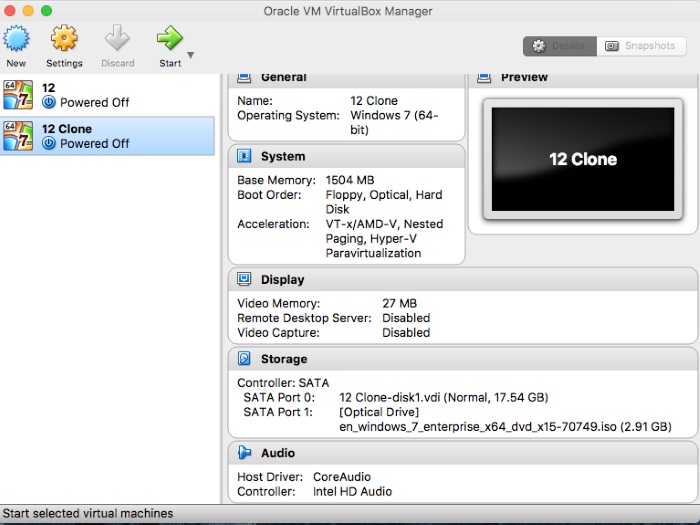
Although the Parallels image worked fine with QEMU and later on also in our Oracle VM Server as a hw virtualized XEN machine, i was not content and i looked out for VirtualBox which is available under a GPL license without USB support which i don’t need, but is able to use Intel VT-x and AMD-V technology.
Virtualbox Vs Parallels Performance
I needed to convert the Parallels image from a raw disk format to innoteks vdi format, following the steps explained here.
All the tools mentioned there are also available under a Windows installation of QEMU and Virtualbox. Commands as follow:
For bridged networking unter VirtualBox the same applies as to QEMU without the need for OpenVPN, you can add a TAP device right from within VirtualBox . If you already have the bridged described above, you can add the VirtualBox interface with a right click to that bridge. Also, to have Debian not change the eth number, add the same mac address in the network tap of VirtualBox.
All this said and done, booting the system was blazing fast and also the backup of my Daily Fratze project which is pulled via rsync from my server, runs extremly smooth and i have absolutely no hassle setting up Ruby on Rails, RMagick and MySQL under the Windows “Operating System” but can use Debian or any other distro with a sane environment.
After fiddling around with both VMWare and VirtualBox, i’d prefer VirtualBox over VMWare Server (which is also available for free {i.e. for giving VMWare your personal data}). VirtualBox has less overhead then VMWare Server, is simple to configure and as i said, amazingly fast.
When the OS X version leaves beta, i’ll switch from Parallels on my Mac to VirtualBox, at least for my server live backup, so i can make it redundant with the one some kilometres away (call me paranoid if you like) at my workplaces PC.
Parallels Desktop Ou Virtualbox
16 comments
One Trackback/Pingback
Parallel Desktop For Windows
[…] lesen; mit diesem Dreisprung klappt’s. (Wer will, kann übrigens dem Vernehmen nach auch mit dem Opensource-Emulator qemu herumspielen – das muss man […]
Post a Comment