
Microsoft Excel has the basic features of all spreadsheets, using a grid of cells arranged in numbered rows and letter-named columns to organize data manipulations like arithmetic operations. It has a battery of supplied functions to answer statistical, engineering, and financial needs. Microsoft Excel 2013 is a program that allows you to discover and reveal the insights hidden in your documents data. You can access, edit and view documents, perform complex analyses quickly, summarize your data with previews of various pivot-table options, so you can compare them.
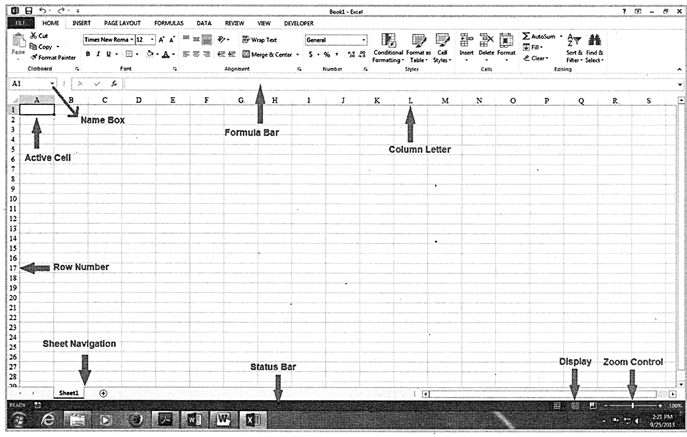
77-420: Microsoft Excel 2013
Languages: English, Chinese (Simplified), Chinese (Traditional), German, Spanish, French, Italian, Japanese, Korean, Norwegian, Dutch, Polish, Portuguese (Brazil), Russian, Arabic (Saudi Arabia), Greek (Greece), Vietnamese (Vietnam)

Retirement date: none
A core-level candidate for the Microsoft Excel 2013 exam should have a fundamental understanding of the Excel environment and the ability to complete tasks independently. They should know and demonstrate the correct application of the principal features of Excel 2013. These candidates should be able to create and edit a workbook with multiple sheets for a variety of purposes and situations. Examples include professional-looking budgets, team performance charts, sales invoices, and exercise logs. Candidate roles might include students, clerical workers, bookkeepers, instructors, and others.
Price based on the country in which the exam is proctored.
Ms Excel 2013 Tutorial
for Microsoft Excel 2013All objectives of the exam are covered in depth so you'll be ready for any question on the exam.
How long have you been using Microsoft Excel?
Have you ever thought how Excel or the other electronic spreadsheet softwares came to existence?

Ms Excel 2013 For Pc
In today’s post, we will go back in time to trace the origin of Excel. So, here we go:
While the origin of electronic spreadsheets can be traced back to 1978, but it wasn’t until 1982 when Microsoft jumped into the arena of Electronic spreadsheets with a product known as MultiPlan.
Muliplan was Microsoft’s first electronic spreadsheet program. It was introduced in 1982 as a competitor for VisiCalc (the first ever electronic spreadsheet program). The key difference between Multiplan and its competitors was Microsoft's decision to use R1C1 addressing instead of the A1 addressing which was introduced by VisiCalc.
Muliplan was very popular on CP/M systems, but on MS-DOS systems it lost fame to Lotus 1-2-3. This thing motivated Microsoft to develop another spreadsheet product Excel.The first version of Excel was released in 1985 for Mac. Later in November 1987, the first Windows version was released.
It all started with VisiCalc:

In 1978, Harvard Business School student Dan Bricklin developed a program called VisiCalc. It was a relatively small program with few basic capabilities. Can i download google docs to my mac. It could only calculate data within a matrix of 5 columns by 20 rows.
To make VisiCalc more powerful Bricklin hired Bob Frankston, who is also known as the co-creator of VisiCalc. Frankston made the program fast and with better arithmetic. VisiCalc was an instant success and the duo were able to sell around 1 million copies of the program.
Note: You can still download an original copy of Visicalc from Dan Bricklin’s website: http://www.bricklin.com/history/vcexecutable.htm [size: 27 K]
What followed VisiCalc?
After the phenomenal success of VisiCalc, a team headed by Mitch Kapor in 1983, developed a new spreadsheet program called Lotus 1-2-3. Mitch and his team power packed Lotus 1-2-3 with charting, graphing and rudimentary database capabilities along with the basic arithmetic. This made Lotus 1-2-3 a new favourite in the industry.
Although, before this in 1982 Microsoft had already launched Muliplan but it was outshined by Lotus 1-2-3. And this thing provoked Microsoft to come up with Microsoft Excel and rest is history.
The Infographic on History of Microsoft Excel:
This infographic takes a closer look at the history of Excel, circa 1978-2013.