
- Torque Converter Replacement Cost Nissan Sentra
- Torque Converter Replacement Cost Subaru Outback
- Cadillac Torque Converter Replacement Cost
- Average Torque Converter Replacement Cost
- Cost To Rebuild Torque Converter
- Torque Converter Replacement Cost F150
(Updated on January 14, 2020)
The engine’s rotational power needs a torque converter in order for this torque to be transmitted to the vehicle’s transmission system. The torque converter is located in between the engine and the transmission.
Agreed with missleman; get another opinion. Torque converters are not a problem with Subarus and I suspect there’s a misdiagnosis involved. Anything is possible but odds are against this one. Ask these guys if they’re willing to put it in writing about refunding your 1500 bucks if the problem still exists after the converter replacement.
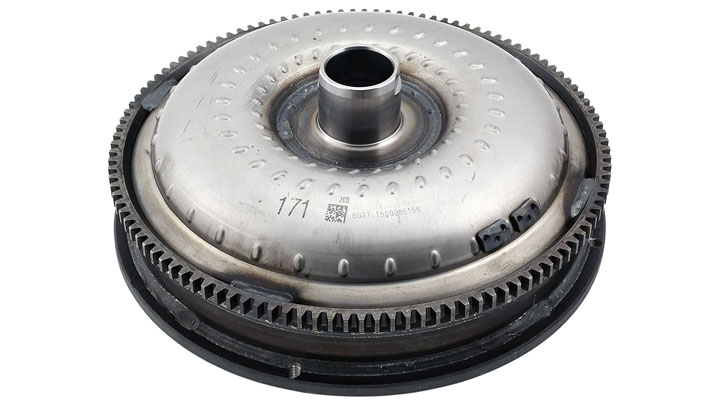
This can be an expensive repair as the only way to access the torque converter seal is to remove the transmission from the vehicle. Pricing can start from $500 and reach $1000 and higher, depending on how labour intensive the transmission removal is. What is a torque converter seal? I had the torque converter replaced under warranty by the dealer on my ‘12 XLE 4 Cyl. The severe shudder went away but ever since replacement the engine lugs between 30-40 mph under light throttle and it slip shifts gears 2-4 when cold. I took it back to the dealer and they told me the only way to fix those issues was to replace the transmission. Its job is to send the power and torque from the engine onto the transmission. The torque clutch prevents lockup at high speeds, and the solenoid for that clutch controls the fluid pressure of the clutch and causes it to open and close at the right time. If the solenoid needs to be replaced, then it may cost you between $85 and $400.
There is a flex plate in this area where the torque converter is installed onto. Once the crankshaft moves, the flex plate spins and allows the conversion of the torque energy from the engine to the transmission to take place.
When there is a problem with the torque converter, people often misunderstand the symptoms and think something is wrong with their transmission itself. This would be a very expensive assumption to make because if you have a mechanic replace your transmission, you are going to be spending thousands of dollars on another one.
It would have been much cheaper to just have the torque converter replaced instead so knowing the signs of a faulty torque converter can save you a lot of money.
Top 5 Bad Torque Converter Symptoms
Here are five of the most common symptoms that may indicated a bad torque converter.
1) Strange Sounds
A bad torque converter will cause whining or rattling noises will be heard. These noises will be louder when you are driving versus when you are parked.
But once you go from park to drive, the noises will get louder and more frequent. In any event, you should take these noises seriously.
2) Speed Changes
You may be driving along and notice sudden decreases or increases in your vehicle’s acceleration. This happens when you have a faulty torque converter which is causing its output pressure to be inconsistent.
If you have to drive under tough weather conditions, it will get very dangerous to have this problem occurring.
3) Shakiness
When you accelerate your vehicle to about 40 miles-per-hour and it feels shaky, this could mean that your torque converter has issues. It might have the same feeling as if you’re driving on a bumpy road.
There will be no advanced warning of when this will happen either. But when it happens the first time, get your vehicle to a mechanic right away. While the problem may also indicate a problem with your suspension or tires, you need to get it checked out nonetheless.
4) Transmission Slipping
A bad torque converter won’t be good at managing the amount of transmission fluid that it sends into the transmission. Sometimes it will send too much fluid and other times it won’t send enough.
As a result, there will be slippery gears inside of the transmission which then causes the acceleration to decrease. This means that more fuel will be consumed which will lower the vehicle’s fuel economy.
However, make sure that you have an adequate amount of transmission fluid in the system because sometimes having a low amount will cause this symptom to happen too.
Related: 5 Steps to Check Automatic Transmission Fluid
5) Shifting Problems
If the torque converter is bad then its output pressure will be lower. This means that your shifts will feel very soft or they will be greatly delayed. As time goes on, the shifts will feel very hard and rough.
The only way to reverse this is to make the output pressure of the torque converter better. This requires the engine’s RPM to be higher. But, you will need to a new torque converter in order to make that happen.
Torque Converter Replacement Cost
The replacement cost of a bad torque converter won’t exactly be cheap, but it will still be cheaper than replacing an entire transmission. For those who are mechanically inclined, you can perform the torque converter replacement job yourself at a cost of about $200 to $600 in parts, and probably a day or two of your time. This is not a job for beginners.
But if you are going to have a transmission shop or auto repair shop replace the torque converter, then it will cost between $400 and $700 just for the labor. The reason the labor costs are so much is that the mechanic will need to remove the transmission in order to access the torque converter.
Add in the cost of parts and you’re looking at a minimum of $600 to $1,300 for the total cost of torque converter replacement. In addition, expect to pay even more for vehicles such as sports cars and luxury vehicles or if you have a dealership perform the job.
Reading Time: 8minutesAs technology and innovation continues to rise in the automobile industry, the vehicle got improved. The shift from the clutch to the torque converter is such an example. Being a wonder in the industry, it is only normal that this component gets enough attention. As such, this article gives a complete guide on the torque converter, including the cost of repair.
One of the best things about this component remains the fact that it is purely mechanical. Both in structure and function. Its nature helps the torque converter to carry out its function smoothly and seamlessly. Whenever you drive, and that acceleration comes smoothly and deceleration, remember this component that made it possible.
Table of Contents
- 2 Components and structure of torque converters
- 3 How torque converters function
- 5 Caring for torque converters
- 6 Repairing and replacing torque converters
- 6.1 Diagnosing issues with torque converters
What are torque converters?
As a replacement for the clutch in manual vehicles, torque converters regulate and transfer power from the engine to the transmission. They allow the engine to keep running while the vehicle tires slow down or when the vehicle stops.
Being a type of fluid coupling allows the engine and transmission to operate independently of each other to some extent.
You will find this component situated between the engine and the transmission system of the vehicle. This location makes sure that the two parts of a car do not contact each other. The converter carries out any required connections.
This part of the car remains one of the least understood components in an automatic transmission vehicle.
Components and structure of torque converters
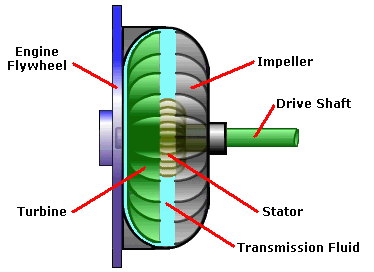
Torque converters are made up of an impeller, turbine, transmission fluid, stator, and torque converter clutch.
Impeller/pump
This component is attached to the engine’s crankshaft. It also spins with it all the time. When the impeller starts to spin, it catches the transmission fluid. The generated centrifugal force moves the fluid to the edges of the pump.
The force with which the fluid moves depends on the speed at which the impeller spins. The turbine -which also spins- receives the fluid from the impeller.
Turbine
The turbine faces the opposite direction of the pump. As soon as the transmission fluid gets to the turbine’s blades, it causes them to start spinning. The blades’ rotation sends the fluid to the turbine’s center and then pushes it back to the stator and pump. This occurs as a cycle between the impeller and the turbine.
Also, while the impeller acts as the part attached to the engine’s crankshaft, the turbine does the same but for the rest of the transmission.
Stator
Sometimes known as the converter’s reactor, the stator sits centrally between the turbine and the pump. While the stator resembles the impeller, it is different in size and function. The stator is smaller than the pump, and it collects the fluid coming from the turbine.
It also regulates and decides the rate at which the transmission fluid flows back to the impeller. The stator structure forces the fluid to flow back to the pump more slowly compared to when it’s flowing to the turbine.
This occurrence significantly increases the torque.
Transmission fluid
This is the fluid found inside torque converters. It flows from the pump to the turbine and back. In so doing, the transmission fluid spins the blades of both components, multiplying the engine’s torque.
However, kindly note that the fluid can get contaminated and when this happens, make sure to change it.
Torque converter clutch
The primary function of the clutch is to lock the impeller and turbine. This lock makes them rotate at the same speed till the clutch disengages.
Before the addition of the clutch, torque converters could not deliver optimally due to energy loss. When the car begins to slow down and stops because of the absence of a clutch, energy gets lost.
With the addition of the clutch, torque converters can now maximize their efficiency. Because now, energy isn’t needlessly lost.
For more on torque converter clutches, check out this article put together to explain this component better.
Torque Converter Replacement Cost Nissan Sentra
How torque converters function
For the torque converter, the engine can connect to the rear wheels to control them. Also, to allow the engine to disengage from them to keep running while the car stands still. To achieve this, there are a couple of processes going on inside the converter.
Let us take a look at these processes.
Firstly, the impeller connected to the engine begins to spin as soon as the engine starts up. Its blades build up centrifugal forces that push the transmission outwards and towards the turbine blades.
Next, the turbines (which is connected to the rest of the transmission) have their blades funnel the fluid to the center of the turbine and then push it back towards the impeller through the stator. In turn, the stator decides the amount of fluid reaching the impeller and the speed of the fluid. Flowing back to the impeller at a slower rate greatly multiplies the torque.

This continues as a cycle. In this way, the fluid acts as the medium through which energy is transferred from the engine to the transmission.
The place of the torque converter clutch
Now, the clutch comes into play when the car is moving at high speed. At this point, the engine and the transmission need to rotate at the same speed. The torque converter clutch locks the engine and the transmission via the impeller and turbine to achieve this and prevent energy loss.
In their locked state, they both rotate at the same rate. Thus, all the energy coming from the engine gets transferred to the transmission of 100%. When the car starts slowing down, the clutch disengages, and the engine and transmission begin to spin independently of each other again.
The clutch can detect when to engage and disengage based on the torque converter clutch solenoid’s existence. This piece can receive inputs and notify the clutch. Check out this article for a better understanding of the solenoid.
Symptoms of bad torque converters
From shuddering to unusual sounds and even overheating, several signs suggest a bad converter. Check out this well-written article on the various symptoms of a bad torque converter. The article also explains the various factors that damage torque converters.
Caring for torque converters
The following are ways to care for the converter in your car. These steps will help you prevent damage to your torque converter while keeping it optimal.
Always make use of the ideal transmission fluid type.
Make sure to check the owner’s manual of your car to find the right type of transmission fluid for your car. A good idea to follow when you aren’t sure of the fluid type is to ask a professional. You can ask your mechanic or contact a repair shop or the manufacturer’s service line.
Wait for the vehicle to warm up before driving.
You should let your car warm up before driving it. This point is more important during the winter season when the environment drops in temperature. When you start your engine, wait for a few minutes to let the engine and the car warm up before driving off.
From time to time, check the transmission fluid.
A lot of modern vehicles now have an easy way of checking the transmission fluid. It is now as easy as checking the motor oil.
If you find the fluid level is low, that can be an indication of a leak. You will recognize the transmission fluid because of its sweet smell and bright red color. If, upon checking, you find the fluid dark, murky, or stinking/smelling bad, take it to the repair shop for diagnosis.
If you can help it, don’t use the vehicle for heavy lifting.
This point belongs to owners of vehicles not built for towing or heavy labor. Avoid using the car for pulling or towing heavy loads as that can damage the transmission.
In hot temperatures, subjecting the car to heavy-duty can cause oxidation of the transmission fluid. This reaction will cause the fluid to burn and will deal a great deal of damage to the transmission.
Avoid changing gears while the car is moving.
Refusing to let the car stop before changing the gear will put a lot of strain on the transmission. Changing gears, in this case, refers to changing from drive to reverse and vice versa.
Putting serious pressure on the transmission from time to time will sooner or later cause serious to it. Let your vehicle stop before proceeding to change the gear.
Always change the filter regularly.
Some cars have a filter for the transmission fluid. If your car falls under this category, make sure to change the filter regularly. A good time to do this is whenever you flush the transmission fluid.
Torque Converter Replacement Cost Subaru Outback
Flush the transmission fluid regularly.
You should always take your car to the repair shop and let the professionals change the transmission fluid. This change should be done regularly.
To determine the best time to change the fluid and how often, check the car’s owner’s manual. Although once a year is an ideal practice to adopt, the frequency for change heavily depends on the amount of driving involved. It also depends on the temperature within which the vehicle operates.
Replace spare tires as soon as possible
Avoid driving with a spare tire smaller than the car’s tire for long periods. The same applies to mismatched tire sizes.
Doing this will ruin the wheel alignment of the vehicle. Over time, it will begin to put a lot of pressure and strain on the vehicle’s transmission.
Regularly service your engine’s cooling system.
This part of your engine prevents overheating. Servicing it from time to time ensures that it operates optimally. With an efficient level of performance, the engine’s overall temperature will remain within the ideal range.
As a result, the temperature will not rise to the level that burns or oxidizes the transmission fluid. Make sure to regularly service the cooling system to ensure that the temperature remains within the optimal range.
Repairing and replacing torque converters
When you encounter a bad torque converter, you have one of two options to make – repair it or replace it. Repairing it attracts more cost compared to replacing. To repair, torque converters have to be opened up, which is difficult in addition to cleaning and reconditioning.
In general, professionals will advise you to opt for replacing the converter. This option costs less, both financially and in terms of labor. It also avoids the risk of causing more harm than good in the long run.
While you can decide to replace it yourself, do not attempt to repair the torque converter. However, replacing the torque converter yourself will cost you around $200 to $500 in addition to about an average of 8 hours for labor.
Taking the car to a repair shop will cost around $600 to $1000. Take note that the cost of changing the transmission fluid might not be included in the amount the shop charges you.
Cadillac Torque Converter Replacement Cost
Diagnosing issues with torque converters
While carrying out each of the steps mentioned, make sure to listen for shuddering, strange noises, or lurching constantly.
First step
Start the vehicle and let it run for some time, warming up in the process.
Second step
Lightly press the gas down several times.
Third step
Push the vehicle’s brake, then move the gear into ‘drive.’
Fourth step
Circle through each gear slowly. Starting with ‘drive,’ shift into the other gears till you return to ‘drive.’
Fifth step
Average Torque Converter Replacement Cost
Drive around while listening attentively for any strange sound or noise each time the car speeds up.
Cost To Rebuild Torque Converter
Key takeaways!
Torque Converter Replacement Cost F150
For the case where you cannot go through the entire article, this section gives you the most important points.
- Torque converters do the work of clutches in automatic transmission vehicles.
- They regulate the transfer of energy from the engine to the transmission.
- The impeller/pump, turbine, transmission fluid, clutch, and stator are torque converter’s components.
- Replacing the torque converter on your own will cost you around $200 to $500 in addition to about an average of 8 hours for labor.
- Taking the car to a repair shop will cost around $600 to $1000.